

CMA Leadership on the Union Budget 2026-27

  As India advances towards a Viksit Bharat, the three kartavya articulated in the Union Budget provide a clear context for the Nation’s growth and aspirations, combining economic momentum with capacity building and inclusive progress. The Cement Manufacturers’ Association (CMA) appreciates the Union Budget 2026-27 for the continued emphasis on manufacturing competitiveness, urban development and infrastructure modernisation, supported by over 350 reforms spanning GST simplification, labour codes, quality control rationalisation and coordinated deregulation with States. These reforms, alongside the Budget’s focus on Youth Power and domestic manufacturing capacity under Atmanirbharta, stand to strengthen the investment environment for capital intensive sectors such as Cement. The Union Budget 2026-27 reflects the Government’s focus on infrastructure led development emerging as a structural pillar of India’s growth strategy.

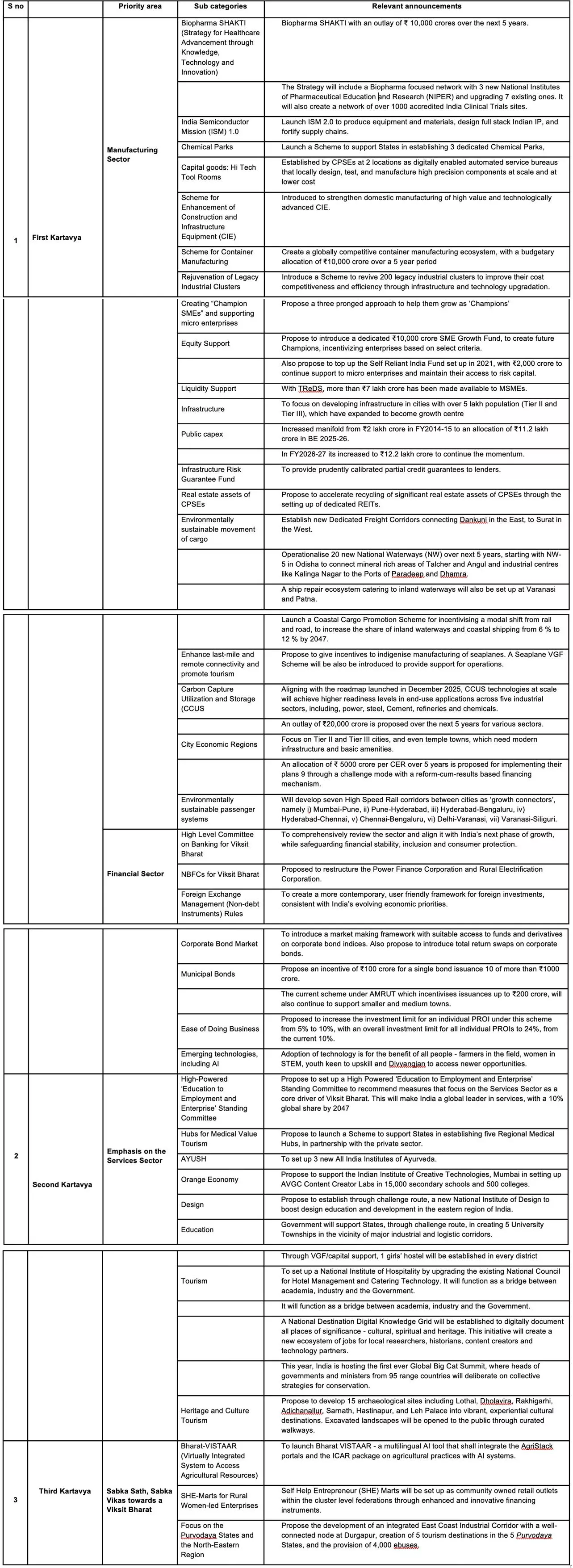
The ₹20,000 crore CCUS outlay for various sectors, including Cement, fundamentally alters the decarbonisation landscape for India’s emissions intensive industries. CCUS is a significant enabler for large scale decarbonisation of industries such as Cement and this intervention directly addresses the technology and cost requirements of the Cement sector in context. The Cement Industry, fully aligned with the Government of India’s Net Zero commitment by 2070, views this support as critical to enabling the adoption and scale up of CCUS technologies while continuing to meet the Country’s long term infrastructure needs.   

Parth Jindal
President, Cement Manufacturers’ Association
and Managing Director,
JSW Cement Limited

  The Government’s sustained infrastructure push supports employment, regional development and stronger local supply chains. Cement manufacturing clusters act as economic anchors across regions, generating livelihoods in construction, logistics and allied sectors. The Budget’s focus on inclusive growth, execution and system level enablers creates a supportive environment for responsible and efficient expansion offering opportunities for economic growth and lending momentum to the Cement sector. The increase in public capex to ₹12.2 lakh crore, the focus on Tier 2 and Tier 3 cities, and the creation of City Economic Regions stand to strengthen the growth of the Cement sector. We welcome the Budget’s emphasis on tourism, cultural and social infrastructure, which should broaden construction activity across regions. Investments in tourism facilities, heritage and Buddhist circuits, regional connectivity in Purvodaya and North Eastern States, and the strengthening of emergency and trauma care infrastructure in district hospitals reinforce the Cement sector’s role in enabling inclusive growth. 

Dr Raghavpat Singhania
Vice President, Cement Manufacturers’ Association
and Managing Director, J K Cement Limited

  As India advances towards a Viksit Bharat, the three kartavya articulated in the Union Budget provide a clear context for the Nation’s growth and aspirations, combining economic momentum with capacity building and inclusive progress. The Cement Manufacturers’ Association (CMA) appreciates the Union Budget 2026-27 for the continued emphasis on manufacturing competitiveness, urban development and infrastructure modernisation, supported by over 350 reforms spanning GST simplification, labour codes, quality control rationalisation and coordinated deregulation with States. These reforms, alongside the Budget’s focus on Youth Power and domestic manufacturing capacity under Atmanirbharta, stand to strengthen the investment environment for capital intensive sectors such as Cement. The Union Budget 2026-27 reflects the Government’s focus on infrastructure led development emerging as a structural pillar of India’s growth strategy.

As India advances towards a Viksit Bharat, the three kartavya articulated in the Union Budget provide a clear context for the Nation’s growth and aspirations, combining economic momentum with capacity building and inclusive progress. The Cement Manufacturers’ Association (CMA) appreciates the Union Budget 2026-27 for the continued emphasis on manufacturing competitiveness, urban development and infrastructure modernisation, supported by over 350 reforms spanning GST simplification, labour codes, quality control rationalisation and coordinated deregulation with States. These reforms, alongside the Budget’s focus on Youth Power and domestic manufacturing capacity under Atmanirbharta, stand to strengthen the investment environment for capital intensive sectors such as Cement. The Union Budget 2026-27 reflects the Government’s focus on infrastructure led development emerging as a structural pillar of India’s growth strategy.  

Parth Jindal
President, Cement Manufacturers’ Association
and Managing Director,
JSW Cement Limited


  The Government’s sustained infrastructure push supports employment, regional development and stronger local supply chains. Cement manufacturing clusters act as economic anchors across regions, generating livelihoods in construction, logistics and allied sectors. The Budget’s focus on inclusive growth, execution and system level enablers creates a supportive environment for responsible and efficient expansion offering opportunities for economic growth and lending momentum to the Cement sector. The increase in public capex to ₹12.2 lakh crore, the focus on Tier 2 and Tier 3 cities, and the creation of City Economic Regions stand to strengthen the growth of the Cement sector. We welcome the Budget’s emphasis on tourism, cultural and social infrastructure, which should broaden construction activity across regions. Investments in tourism facilities, heritage and Buddhist circuits, regional connectivity in Purvodaya and North Eastern States, and the strengthening of emergency and trauma care infrastructure in district hospitals reinforce the Cement sector’s role in enabling inclusive growth. 

Dr Raghavpat Singhania
Vice President, Cement Manufacturers’ Association
and Managing Director,
J K Cement Limited

Union Budget 2026-27 and the Cement Industry in India

Ms Nirmala Sitharaman, Finance Minister, Government of India, spoke of the focus of the Union Budget 2026-27 calling it a unique Yuva Shakti driven Budget with the Government’s Sankalp to focus on the poor, underprivileged and the disadvantaged. Being first Budget prepared in Kartavya Bhawan, the Hon’ble Minister mentioned being inpired by 3 kartavya as follows:

  1. The first kartavya is to accelerate and sustain economic growth, by enhancing productivity and competitiveness, and building resilience to volatile global dynamics.
  2. The second kartavya is to fulfil aspirations of the people and build their capacity, making them strong partners in India’s path to prosperity.
  3. The third kartavya, aligned with the vision of Sabka Sath, Sabka Vikas, is to ensure that every family, community, region and sector has access to resources, amenities and opportunities for meaningful participation.

The Finance Minister stated that the threefold approach required a supportive ecosystem. The first requirement would be directed to sustaining the momentum of structural reforms— continuous, adaptive, and forward-looking. Second, a robust and resilient financial sector was central to mobilising savings, allocating capital efficiently and managing risks. Third, cutting edge technologies, including AI applications, could serve as force multipliers for better governance.

Figure 1 Budget is inspired by 3 Kartavya in Union Budget 2026-27
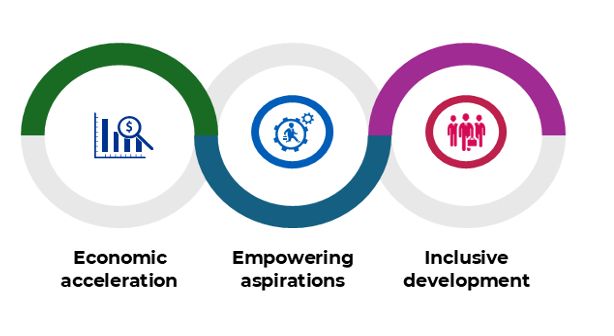
Figure 2 Requirement is to sustain the momentum of structural reforms

Source: Union Budget 2026-27, https://www.indiabudget.gov.in/, accessed on February 1, 2026

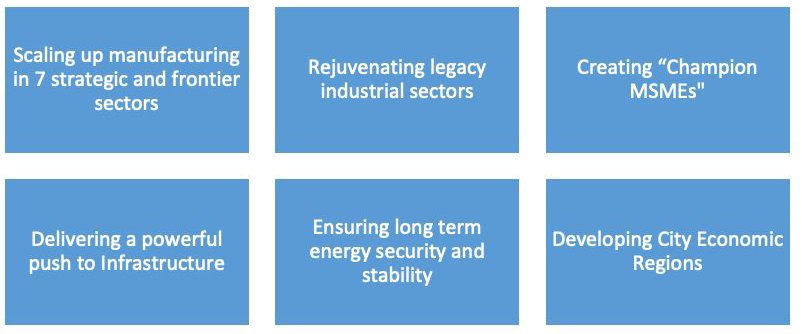
Figure 3 Interventions in six areas to accelerate and sustain economic growth in the First Kartavya
Source: Union Budget 2026-27, https://www.indiabudget.gov.in/, accessed on February 1, 2026

Read More